
Uncategorized
Needle vs Cannula: Which Should You Use for Filler Injections?
Aug
Needle vs Cannula: Which Should You Use for Filler Injections?
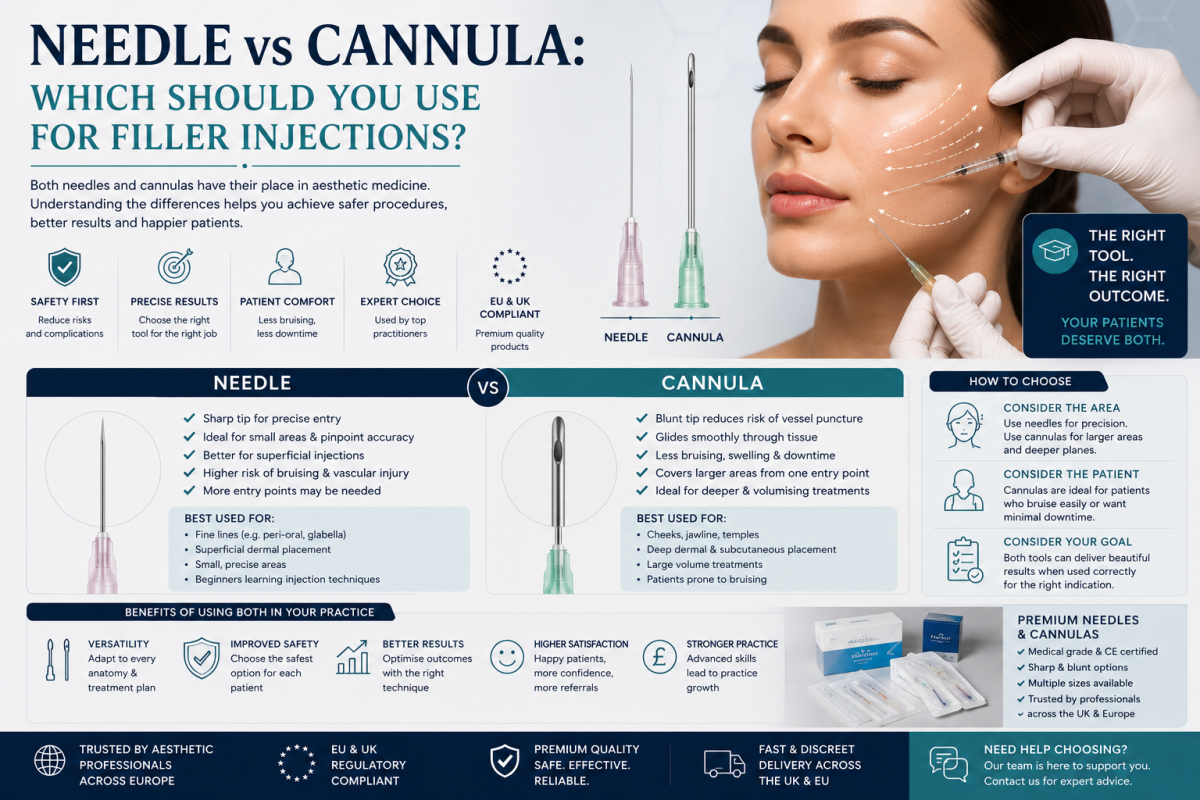
It’s one of the most debated technique questions in injectable aesthetics, and the honest answer is: it depends on what you’re treating, not which tool is universally “better.” Both needles and cannulas have a genuine place in a well-run injection protocol — understanding when each one is the right call is what separates confident technique from habit.
The Core Difference
A needle has a sharp, bevelled tip designed to pierce tissue directly — it offers precise, single-point control, which makes it the standard choice for targeted work like toxin injections and fine-detail filler placement. A cannula has a blunt, rounded tip that doesn’t cut through tissue but instead slides through it, pushing vessels and structures aside rather than piercing them — this is what makes cannulas the safer default for larger-volume filler work in vascular-risk areas.
Both tools are available across our needles and cannulas category, including precision options from TSK, FMS, and [BD Micro-Fine](https://proaestheticsupply.eu/?s=BD Micro).
When to Reach for a Needle
Needles remain the right choice for:
- Botulinum toxin injections, where precise, targeted single-point delivery matters more than covering a broad area
- Fine-detail lip work, particularly along the vermillion border where control is paramount
- Small, superficial corrections where a cannula’s larger entry point offers no real advantage
Fine-gauge precision needles like TSK’s STERiJECT range or FMS Fine Micro Syringes are engineered specifically to reduce extrusion force and improve comfort during this kind of targeted injection — the thinner the wall construction, the smoother the flow at a given gauge.
When to Reach for a Cannula
Cannulas are generally the safer, more efficient choice for:
- Larger-volume filler work, where covering more area through a single entry point reduces the number of punctures needed
- Higher-vascular-risk zones like the tear trough, temples, and nasolabial folds, where a blunt tip’s ability to push vessels aside rather than pierce them meaningfully lowers the risk of vascular occlusion
- Body filler and volumizing treatments, where large treatment areas make single-entry-point coverage genuinely more practical
Brands like Magicalift, TSK Steriglide, and FMC cannulas are widely used across dermal filler and body filler applications for exactly this reason.
The Safety Argument, Honestly Weighed
Cannulas are frequently marketed as the inherently “safer” option, and there’s real basis for that in vascular-risk zones — a blunt tip is genuinely less likely to penetrate a vessel wall than a sharp needle. But this doesn’t mean cannulas are risk-free, or that needles are unsafe when used correctly by a trained practitioner who understands relevant anatomy. Technique, anatomical knowledge, and aspiration practice matter more than the tool alone — the safest approach is choosing the right tool for the specific area and staying within your own trained competency.
Gauge Selection Matters as Much as Tool Choice
Whichever tool you choose, gauge selection should match the product’s viscosity and the treatment area’s sensitivity:
| Gauge range | Typical use |
|---|---|
| 30–33G (fine) | Toxin, lips, under-eye, delicate PN/PDRN work |
| 27–29G (medium) | General filler and skin booster injection |
| 22–25G (larger) | High-viscosity fillers, larger cannula work, body filler |
Frequently Asked Questions
Is a cannula always safer than a needle for filler injection? Generally lower-risk in vascular areas due to its blunt tip, but “safer” depends heavily on correct technique and anatomical knowledge — neither tool eliminates risk on its own.
Can I use the same product with both a needle and a cannula? Yes, in most cases — the tool choice is a technique decision, not a product restriction, though very high-viscosity products may require a larger-gauge cannula to inject smoothly.
Why do some skin boosters come without a needle included? Many skin booster products, including several in our range, are supplied without a needle so practitioners can select the gauge best suited to their preferred technique and treatment area — always check the product listing and order separately if needed.
What’s the best all-purpose cannula gauge to keep stocked? Most clinics find a 25G cannula in 38–50mm length covers the majority of facial filler applications, supplemented by finer 27–30G options for more delicate areas.
Stocking the Right Tools
ProAestheticSupply.eu stocks precision needles and cannulas from TSK, FMS, [BD Micro-Fine](https://proaestheticsupply.eu/?s=BD Micro), and Magicalift, with fast delivery across the UK and EU. Browse our full needles and cannulas range, or pair your order with dermal fillers and skin boosters to complete your treatment kit. Check our FAQs for ordering details, or contact our team if you need help selecting the right gauge for a specific technique.
