
Uncategorized
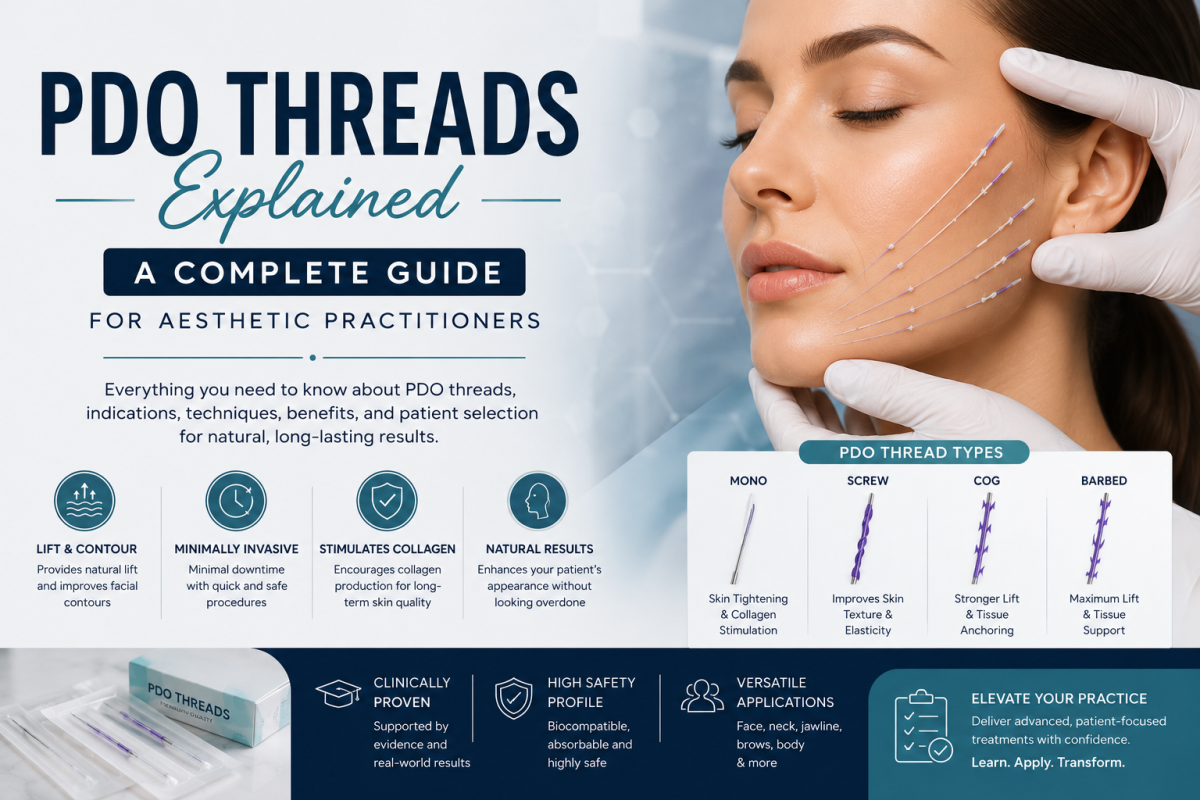
PDO Threads Explained: A Complete Guide for Aesthetic Practitioners
Aug
PDO Threads Explained: A Complete Guide for Aesthetic Practitioners
Thread lifting has quietly become one of the most requested non-surgical treatments in aesthetic medicine — patients want a lifted, tighter look without surgery, and PDO threads deliver exactly that. But “PDO threads” isn’t one product, it’s a category with real technical differences between thread types, and choosing the wrong one for the wrong area is a common reason results underwhelm. Here’s what every practitioner should understand before picking up a thread kit.
What Are PDO Threads?
PDO threads (polydioxanone threads) are absorbable, surgical-grade sutures — the same biocompatible material used in wound closure for decades — repurposed for non-surgical facial lifting. Once inserted, they work through two separate mechanisms: an immediate mechanical lift from the thread’s physical placement, and a longer-term collagen-stimulating effect as the body responds to the thread’s presence with new collagen and elastin production. That second effect continues even after the PDO material has fully absorbed, typically over 4–6 months.
The Three Thread Types, and What Each One Is Actually For
Mono threads are smooth, single-strand filaments. They don’t grip tissue the way barbed threads do, so they’re used primarily for skin tightening and fine-line reduction — think of them as a stimulation tool rather than a lifting tool. Brands like Lifskin offer mono threads in multiple gauges for different sensitivity levels.
Cog threads feature small barbs cut along the thread in a helical or directional pattern. These barbs grip surrounding tissue, which is what gives Cog threads their genuine lifting capability — they’re the choice for areas with visible sagging, like the jowls or mid-face. Magicalift and Lifskin both offer 3D/4D Cog variants with barbs positioned at multiple angles for maximum anchoring strength.
Screw threads are twisted, often in pairs, and are typically used to add volume and improve texture in a specific localised area rather than deliver a broad lifting effect.
Choosing the Right Thread for the Treatment Area
| Concern | Best-suited thread type |
|---|---|
| General skin laxity, prevention | Mono |
| Visible jowl or cheek sagging | Cog (barbed) |
| Localised volume/texture concern | Screw |
| Nose or fine facial contouring | Fine-gauge Cog or nose-specific Cog (e.g. Lifskin’s Nose Cog range) |
Gauge and length matter just as much as thread type — a 19G Cog thread built for jawline lifting is a very different tool from a 30G mono thread meant for delicate periorbital tightening. Always match gauge to the specific anatomical zone rather than defaulting to whatever’s already in your kit.
How PDO Threads Compare to Filler and Skin Boosters
Threads solve a problem that neither dermal fillers nor skin boosters fully address on their own: mechanical lift of sagging tissue. Filler adds volume, skin boosters improve tissue quality, but neither physically repositions skin the way a barbed Cog thread can. This is why threads are frequently combined with both — filler to restore volume that’s been lost, threads to lift what’s sagging, and a skin booster like Rejuran or [Plinest](https://proaestheticsupply.eu/?s=Mastelli Plinest) to improve the skin’s underlying quality once structure is addressed.
What Recovery and Aftercare Actually Look Like
Most patients experience mild swelling, tenderness, and visible or palpable “puckering” for the first 1–2 weeks as tissue settles around the threads — this is normal and expected, not a complication. Standard aftercare guidance includes avoiding excessive facial movement, chewing tough foods, and dental work in the treated area for around 2–3 weeks, plus sleeping in a position that avoids pressure on the treatment zone.
Frequently Asked Questions
How long do PDO thread results last? The mechanical lift typically holds for several months, while the collagen-stimulating benefit can continue improving skin quality for up to a year or more, even after the threads themselves have fully absorbed.
Do PDO threads hurt? Most protocols use local anaesthetic before thread insertion, and patient-reported discomfort is generally described as manageable — comparable to filler injection, with some added pulling sensation during placement.
Can PDO threads be combined with dermal fillers in the same session? Yes — many practitioners perform threads and filler in the same visit, though sequencing (which first) depends on the specific treatment plan and areas involved.
What needles or cannulas do I need for thread insertion? Thread insertion tools are usually pre-loaded with the thread kit itself (a needle or cannula matched to that specific product), but for any complementary filler or booster work in the same session, check our needles and cannulas range.
Stocking Your Thread-Lifting Menu
If you’re building out thread lifting as a service line, ProAestheticSupply.eu stocks CE-approved PDO threads across Mono, Cog, and Screw types, with fast delivery across the UK and EU. Browse our full PDO threads range, including Lifskin and Magicalift, or pair your order with dermal fillers and skin boosters for a complete lift-and-rejuvenate protocol. Check our FAQs for ordering details, or contact our team if you need help selecting the right thread type for a specific patient case.
