
Uncategorized
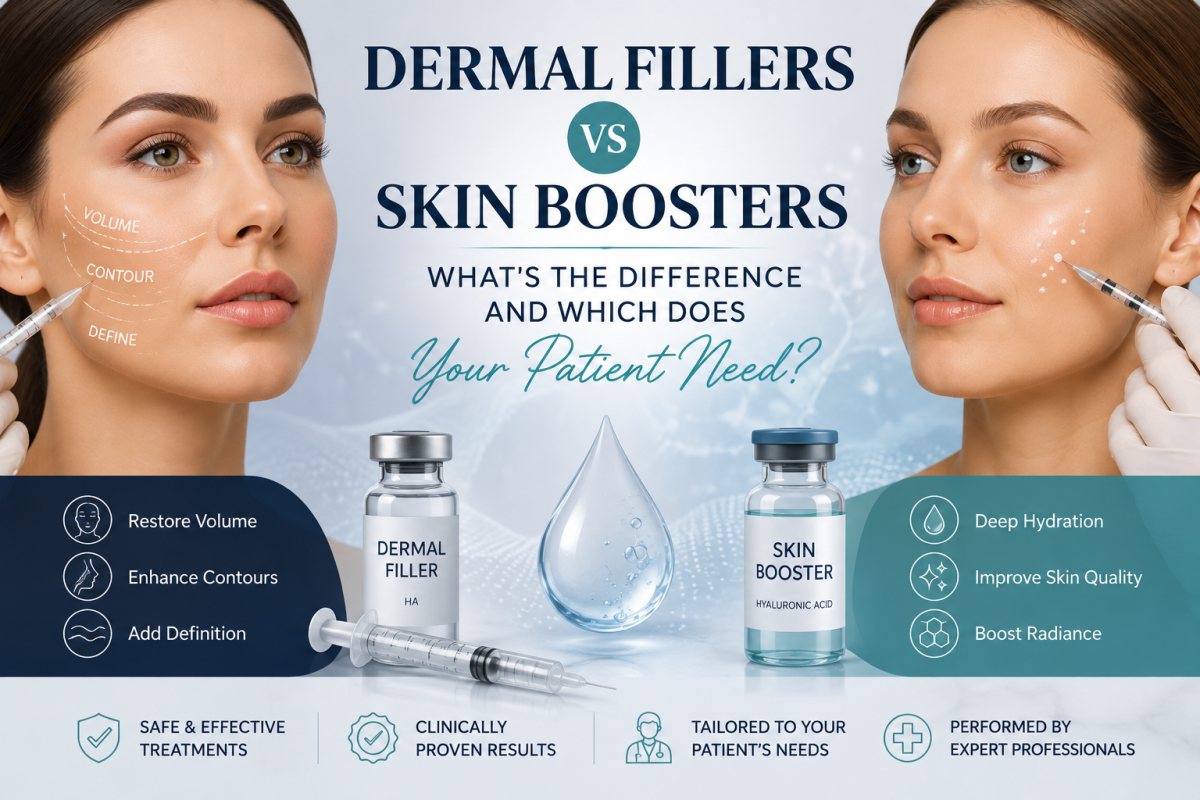
Dermal Fillers vs Skin Boosters: What’s the Difference and Which Does Your Patient Need?
Aug
Dermal Fillers vs Skin Boosters: What’s the Difference and Which Does Your Patient Need?
If you’ve ever had a patient ask “should I get filler or one of those skin boosters?”, the honest answer is: it depends on what their skin actually needs. These two treatment categories get lumped together constantly, but they work in completely different ways — and understanding that difference is the difference between a patient who’s thrilled with their result and one who’s disappointed because the treatment never addressed their actual concern.
The Short Answer
Dermal fillers are cross-linked hyaluronic acid gels designed to physically add volume and structure — they fill hollows, lift contours, and smooth deep static wrinkles. Skin boosters are lighter, often non-cross-linked or lightly cross-linked injectables designed to improve hydration, elasticity, and overall skin quality from within, without changing facial shape. If a patient’s concern is “I’ve lost volume in my cheeks,” that’s a filler conversation. If it’s “my skin looks dull and tired,” that’s a skin booster conversation.
What Dermal Fillers Actually Do
Dermal fillers work by physically occupying space beneath the skin. The degree of cross-linking in the hyaluronic acid determines how firm, cohesive, and long-lasting the gel is — denser, more heavily cross-linked formulas like Juvéderm Voluma or Stylage XL are built for structural lift in the cheeks and jawline, while softer formulas like Teosyal RHA 2 or Restylane Kysse are engineered to flex naturally with expression in areas like the lips.
Most fillers last 6–18 months depending on the product, treatment area, and patient metabolism, with denser formulas in less mobile areas (cheeks, chin) generally lasting longer than softer formulas in highly mobile areas (lips).
What Skin Boosters Actually Do
Skin boosters take a fundamentally different approach. Rather than adding volume, they’re designed to hydrate and improve the skin’s own quality — some, like Hyaron or Profhilo, use non-crosslinked hyaluronic acid that distributes evenly through tissue rather than sitting as a discrete deposit. Others, like Rejuran or Vitaran, use polynucleotides (PN/PDRN) to stimulate the skin’s own collagen and elastin production at a cellular level.
This is why skin boosters are often the better starting point for patients newer to injectables — they address hydration, texture, and early signs of ageing without changing how someone looks structurally, which tends to feel like a lower-commitment first step.
The Key Question That Decides Which One You Need
Ask: is the problem volume loss, or is the problem skin quality?
- Sunken cheeks, flattened jawline, deep static folds, thin lips → filler territory
- Dullness, dehydration, fine crepiness, early textural changes → skin booster territory
- Both at once (very common in patients over 35) → a combined protocol
Why Combining Them Is Often the Best Answer
In practice, many of the best results come from using both categories together rather than choosing one. A patient getting dermal filler for cheek volume often benefits from a course of Rejuran or Sunekos alongside it — the filler restores structure while the skin booster improves the quality of the skin sitting on top of that structure. This layered approach is increasingly standard in comprehensive rejuvenation planning.
Frequently Asked Questions
Can skin boosters replace dermal fillers? No — skin boosters don’t add meaningful volume, so they can’t replace a filler where structural correction is genuinely needed. They’re complementary, not interchangeable.
Which lasts longer, a filler or a skin booster? This varies by specific product, but generally dermal fillers (6–18 months) outlast skin boosters (6–12 months), since fillers are built with denser cross-linking specifically for durability.
Is one category safer than the other? Both categories are CE-marked medical devices when sourced properly, with well-established safety profiles. Neither is inherently “safer” — the right choice depends on matching the product to the clinical need, not on one category being lower-risk than the other.
What should I stock if I’m building out both categories? Start with a versatile mid-viscosity filler like Revolax or Neuramis for general volumizing work, paired with a well-known skin booster like Profhilo for bio-remodelling — this combination covers the majority of new-patient consultations.
Building Your Treatment Menu
Whether you’re expanding into skin boosters for the first time or refining your filler range, ProAestheticSupply.eu stocks CE-approved products across both categories with fast delivery across the UK and EU. Browse our full dermal fillers range and skin boosters range, or check our needles and cannulas selection to make sure you’ve got the right injection tools for both treatment types. If you’re unsure where to start, our FAQs page covers common ordering questions, or contact our team directly for product recommendations tailored to your patient base.
